
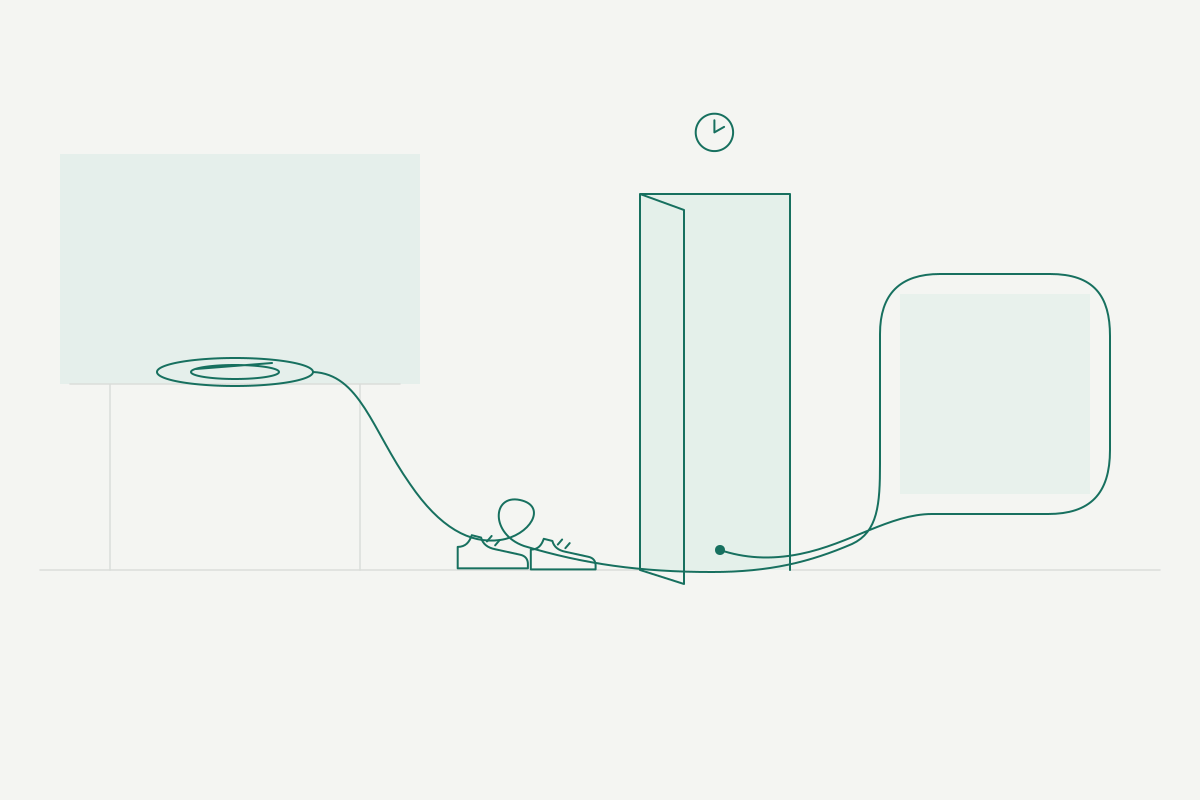
Most people expect the walk to be the hard part of the first night. It rarely is. Ten minutes on your own street is short. What trips people up is everything around the walk: the shoes are upstairs, the half hour slides past while the dishes get done, and the walk turns into a plan for later that never arrives. So this is a guide to the whole first evening of stage 1, from the last bite to the moment you come back through the door.
Stage 1 asks for one thing: a ten minute walk after dinner, every night for a week, plus one longer walk on a day you choose. Lunch gets its walk at stage 3 and breakfast at stage 5. Starting this small is not a warm-up you can skip. It's the part of the plan that builds the habit, and every walk added later sits on top of it.
Get the shoes ready before you sit down
Before dinner, put your walking shoes by the door you'll leave from. If the evening is cool, hang a jacket on the hook beside them. It sounds too small to matter. Skip it, though, and the rest of the evening gets harder.
The reason is simple. After a meal, most of us drift. If the shoes are in a closet upstairs, fetching them is a decision, and decisions are easy to put off. If they're by the door, the next step is obvious. You don't need special shoes for this. Anything comfortable that you can walk in for ten minutes will do on the first night.
While you're at it, open the program in your browser. The Today screen shows a Dinner tile with a 10:00 timer, and you'll press it as you step outside.
Leave inside the half hour, not at a set time
Ten After doesn't give you a clock time. It gives you a window: leave any time in the half hour after you finish eating. If dinner ends at 7:10, you can go at 7:15 or at 7:40, and both count.
The window exists because evenings aren't tidy. Someone needs a bath, a call runs long, a child wants help with homework. A fixed time would break on the first busy night, while a window that moves with your meal bends instead. What the window doesn't do is stretch. If you leave an hour later, the walk has drifted away from the meal, and the meal is the cue the whole habit hangs on.
On the first night, go early in the window if you can. Clear your plate, stand up and walk to the door. The dishes will still be there in ten minutes.
What closing the kitchen means on night one
The second half of the method happens at the door. When your shoes go on, the kitchen is closed for that meal. That means no seconds when you get back, and no grazing from the fridge while you decide what to watch.
This is not a food rule, and Ten After doesn't have any. You eat what you like at dinner. The shoes simply mark the end of the meal, the way a bell marks the end of a class. For a lot of people, the meal isn't where the evening goes wrong; the slow hour after it is. The walk takes the first part of that hour, and the closed kitchen covers the rest.
On night one, say it out loud if it helps: shoes on, kitchen closed. It may feel a little silly the first time. It also tells anyone you live with exactly what's happening, which saves a conversation later.
What to do when you come back in
Walk at a pace where you could still hold a conversation. There's no target speed and no step count. When the timer reaches zero, turn for home if you haven't already, and log the walk on the Dinner tile once you're back.
Logging matters more than it looks. Each logged walk moves your marker one step along the route map, and by the end of the week you can see seven steps in a line. On some nights that line is what gets you out the door. If it rains, don't skip. Take an indoor swap instead, a hallway, a flight of stairs or laps of your home for the same ten minutes, and log it the same way.
Then read the stage 1 guide if you haven't yet. It takes about five minutes, and it covers the week ahead.
Your first long trek at the end of the week
On the day you picked, take the long trek: one walk of 20 minutes. It doesn't need to follow a meal, though you might put it after a weekend lunch, when the time is free. Go a little further than your usual loop and notice where the extra ten minutes takes you. Next week the long trek grows to 25 minutes, and it adds five minutes every stage until it reaches 75 at stage 12.
By the end of the first week you'll have seven short walks and one longer one in your log. That's the whole of stage 1, and it's enough. Stage 2 asks you to do the same week again before lunch joins in, because two weeks of the same small thing gives a habit a better chance to settle before anything is added to it.
If you'd like to start tonight, Ten After Solo is $79 one time, with a full refund within 14 days. Put your shoes by the door before you sit down to eat.